Wednesday, January 26, 2011

Uncle Boonmee, Take Two: Radical Nostalgia


(Apichatpong Weerasethakul's latest, Uncle Boonmee Who Can Recall His Past Lives, is an incredible film. So much so that I'm planning on seeing it three times, in two different theaters, and bloggin' a new post for each viewing. Hopefully, this will help me get at the astonishing play of ideas at work in this movie; if not, at least it'll be an unusually-for-me organized attempt. Either way, really. Stay tuned!)

Just before dashing over to the BFI for my second viewing of Uncle Boonmee, I finished reading Patrick Curry's fascinating Defending Middle-Earth: Tolkien, Myth and Modernity, which I stumbled upon a couple of weeks ago at a Wiccan bookstore. My relationship to The Lord of the Rings is, I imagine, quite typical for my generation: as a nerdy, book-loving kid, I first read it a little too young, and was left nonplussed by its fiercely ecological and unabashedly English elements. So, of course, the movies were perfectly designed for 13-year-old me, and I embraced them wholeheartedly (upon recent re-viewing, I have reservations, but that's another topic). Curry's passionate, insightful book is equally perfect for 21-year-old me, delving as it does into the multi-tiered mythology and anti-modernist subtext of Tolkien's epic, which I now can't wait to re-read for the first time in years. But back to the silver screen...

I walked into the BFI's Studio Theatre with plenty of half-thoughts from my first viewing to complete, but as I watched Apichatpong Weerasethakul's magisterial fable again unfold, Defending Middle-Earth kept returning to mind. Curry takes to task critics who've lazily dismissed Tolkien as a simplistic, sentimental reactionary, defending Middle-Earth as a locus of principled opposition to (and, yes, retreat from) the flattening and destructive forces of technological modernity. Nostalgic, yes, but never disingenuous and never passive: Curry's term is "radical nostalgia," an idea I loved immediately and which stuck with me throughout my second take on Uncle Boonmee.


As Apichatpong's work has gradually gained recognition outside his native Thailand (culminating in Uncle Boonmee's Palme d'Or), western critics have taken upon themselves the usual task of describing his films in terms of western influences, for their readers' sake (and for their own, probably). Certainly, films like Blissfully Yours and Syndromes and a Century are so generous of spirit that they could easily appeal even to subtitle-haters, and so the question (as usual, IMO) is really one of distribution rather than translation, but that, again, is another topic. Besides, I'm as guilty as anyone--in my last post, I compared Apichatpong to David Lynch multiple times, and I probably will again before I'm done. I've also frequently heard him stacked up next to Renoir and Malick, both of which are valid enough reference points (after catching All About My Mother at the BFI last night with fresh eyes, I'd add Almodóvar to the list as well). Yet Tolkien is perhaps the closest thing to a Western kindred spirit to Apichatpong's latest; specifically, those aforementioned elements of Rings that stand in fierce ideological opposition to the Wagnerian sound-and-fury employed by Peter Jackson & Co. Like Tolkien's book, Uncle Boonmee realizes its subtle social polemics via wholly immersive fantasy, including lived-in magic, a constant sense of multiple unfolding stories, and above all, a revelatory emphasis on place, with characters inextricably linked to their homes in nature. Radical nostalgia, indeed.

I closed my last post by arguing that Uncle Boonmee represented the collapsing of spaces (modern/ancient, real/mythical) that Apichatpong had previously kept separate even as they naturally cross-fertilized. It would be easy, then, to cast this film as depicting civilizations in clash, but there's little strife in Uncle Boonmee--a few muttered slurs and a pang or two of homesickness, but that's all. If the circumstances that the titular uncle and his family find themselves in are decidedly fantastic (ghosts, visions, and Wookiees, oh my!), their reactions feel more like a kind of poetic realism. They crack jokes and keep up their routines as long as they can. A reunion dinner for Boonmee, his sister-in-law Jen, and her nephew Tong is interrupted by the Banquo-esque appearance of Boonmee's dead wife Huay and the revelation that the mysterious beast glimpsed at the film's beginning is Boonmee's long-vanished son Boonsong. Shattering stuff, but not five minutes later the camera has again isolated the three flesh-and-blood humans, as Boonmee earnestly begs a stunned Jen to take over his farm when he's gone--after all, if Huay can come back, Boonmee can too, to help Jen with the day-to-day affairs. Tong looks on silently, as he does for most of the scene, which ends when he cracks a goofy, can't-keep-this-in-any-more grin.

This is the milieu in which these people live, and in Boonmee's case, die. Huay and Boonsong have returned because they sense Boonmee's looming death due to kidney failure. He knows it, too: in an earlier scene, even after a doctor has made the trip to drain his kidneys (in a quiet dance of medical making-do very reminiscent of Syndromes and a Century), Boonmee asks him to stay "until the end," and continually reminds a reluctant Jen of the need to think about the future. Just before the doctor scene, Apichatpong shows us something strange and beautiful: a lush, overflowing plain, in which Boonmee has erected several lean-tos below which he grows vegetables. The structures stand out immediately, but nevertheless look completely at home: Apichatpong's artfully arranged mise-en-scène harmonizes man and nature. We cut to Boonmee staring out his bedroom window longingly as the doctor unpacks his equipment. Perhaps we just caught a glimpse of Boonmee's mind's eye, knowing his fate and thinking of the beauty he's been part of.

Windows are a key component of Apichatpong's aesthetic, never more so before than in Uncle Boonmee, where they act as a sort of skin. Renowned political geographer Stephen Jones conceived of border studies in this way--borders as a definite but permeable element of states, allowing for both identification and communication. So, too, do the outside and inside visually blur and bleed into each other in Uncle Boonmee, reflecting the impossibility of separating the titular man's life (lives?) from nature. When Tong first arrives at Uncle Boonmee's, he and Boonmee's assistant Jaai set about unpacking in a darkened room, giving it life as they spread out their things and turn on the lights, but the room's most gorgeous feature remains the glimpses of the jungle's tangle through the open windows.

That jungle is a locus of almost absurd fertility; in the opening scenes featuring the ox, there's a palpable sense that if the camera doesn't keep a close eye on the ground, it'll float off into an eternal arboreal sea. Cross-fertilization--or, sex--is a recurring theme in Uncle Boonmee: Boonsong transforms into a Monkey Ghost (think a Wookiee merged with that thing behind Winkie's in Mulholland Drive) after mating with one, and the film's most memorable side-story involves a mottled princess giving herself over to a catfish-god. Apichatpong's collisions are joyous (and funny), but also messy and a little squeamish, which is probably as it should be. These are the engines by which myth is reified: weird sex and matter-of-fact magic. Sounds right to me, and though Tolkien wasn't exactly the most libidinous of authors, he'd probably agree.

"Radical nostalgia" is that which asserts its place as if there never was anything else, but precisely by making room for the audience, relying on the slow excitement of magic coupled with magic's banality in this strange old world. The trees and valleys of northern Thailand, in Apichatpong's hands, are as fantastic as his film's more overtly mythical elements. These jungles are exactly where we expect magic to be, if it's anywhere. If the woods of New England are where Americans root their (gloomy, terrifying, morally severe) origin myths, as explicated in Irving and Hawthorne, then this jungle is the locus of Apichatpong's career-long pilgrimage. This is where the stories come from, and where they must return. And so must Uncle Boonmee; as Curry quotes Russell Hoban in Defending Middle-Earth, "We make fiction because we are fiction. We make stories because we are story." Step by step in Uncle Boonmee, nature takes back its own.


Yet the story ends in a modern hospital, among his survivors; Apichatpong's fable is broader and messier than simple transcendence. I'm getting more of a handle on what, exactly, it is; I'm looking forward to one more screening (tomorrow night, back at the Prince Charles), but I'm not expecting a feeling of "snapping into place," and I'm glad for that. Uncle Boonmee is above all open-ended; as Curry describes The Lord of the Rings, it's more rooted in hope than longing.

Saturday, January 22, 2011

Uncle Boonmee, Take One: Ghost Stories

(Apichatpong Weerasethakul's latest, Uncle Boonmee Who Can Recall His Past Lives, is an incredible film. So much so that I'm planning on seeing it three times, in two different theaters, and bloggin' a new post for each viewing. Hopefully, this will help me get at the astonishing play of ideas at work in this movie; if not, at least it'll be an unusually-for-me organized attempt. Either way, really. Stay tuned!)


It’s a lamentably typical complaint among filmgoers: “I couldn’t keep my eyes open.” But why does this have to be a negative? Certainly, drifting off in a classroom is a bad sign, for both student and teacher; our standards for art, however, ought to be different. How many of us fight off bouts of insomnia with the help of soothing, hypnotizing music? Few traditions cut across cultures like putting children to sleep with stories. As much as our sacred fables help establish our collective values, fears, and hopes, they also introduce stories as a world in between the conscious world and the unconsciousness of sleep. The best bedtime stories, the ones we return to as curious, analytic adults, are perfectly pitched somewhere among the detritus of history, parable, and fantasy. Universes are blurred, cross-fertilizing, evoking the mixture of preconscious fear and elemental excitement with which kids the world over greet nightfall. Eyelids droop. Dreams follow.


I kept my eyes closed during most of the opening credits of Uncle Boonmee Who Can Recall His Past Lives, the latest cinephilic symphony from Apichatpong Weerasethakul, on whose shoulders I’m increasingly resting the future of the medium. In part, it was the sound. Before any words appeared onscreen, the sprawling basement theater of the Prince Charles Cinema was enveloped in the chirp of insects, the flow of distant streams, the creaking of trees, and that indefinable rustle that seems to hang behind every sound in the natural world. This may sound familiar, even banal, but the restful density of Apichatpong’s soundscapes introduce a calm anticipation like nothing I’ve experienced in any other art—like nothing I’ve experienced in anything outside of deep nature itself. Even the faint gray glow of the screen was too much. I closed my eyes.


I opened them to see an ox, tied to a tree, rooted in a silvery plateau surrounded by shadowy trees. The ox strains to pull free; the rope holding it forms a perfect line against the lush ellipticism of the surrounding environment. Apichatpong cuts to its human keepers, sitting and talking quietly in a nearby glade. The ox finally succeeds and trots off, with increasing speed and confidence, into the nearby jungle. The camera follows at first, but gradually begins to lag behind, lingering on the impossibly tangled trees, as if waiting for something to emerge from this moonlit mystery. Eventually, of course, one of the men finds the ox. A single, unbroken frame watches as he untangles the ox and strains to drag in back; as well as exemplifying Apichatpong’s wry, deadpan humor, the shot avoids any cuts that might have disrupted this enveloping jungle and the enchantment moving within. The latter is finally given concrete form, after a cut necessary and enlivening: a shadowy thing, hunched but huge, with laser-red eyes shining out of the jungle’s dusk.


Whenever I find myself somewhere overwhelmingly majestic, so beautiful as to seem unreal, I like to close my eyes for a moment or two. I imagine myself somewhere familiar, a street in my hometown, or a classroom, or my bed, waking from a dream. Just as I have my body and mind convinced, my eyes snap open again. There it still is: the stormy Atlantic, or the mountains of Hokkaido, or that fantastic creature lurking in Apichatpong’s jungle. When I opened my eyes again to Uncle Boonmee, I had one last glimpse of the beast before the title flashed onscreen. Waking up, or falling asleep?


It’s difficult to say. After the title, we jump out of the jungle and onto the road. The camera hovers inside a sedan, collecting still shots of each silently staring passenger in turn. Certainly, it’s a massive shift in mise-en-scène, and marks the introduction of the narrative proper in lieu of the opening one-off, but one element remains: the forefronting of sound. This time, we’re blanketed by the roar of the engine and the air-conditioning, yet the effect is the same—the sensorial domination of environment. But then, one of the passengers (Auntie Jen, played with immobile kindness by Jenjira Pongpas) cracks her window a bit, and a smile plays across her weathered face. The jungle whips by.


Such subtle dichotomies and ambiguous collisions define Apichatpong’s oeuvre, from which Uncle Boonmee marks both a diversion and an evolution. His earlier treasures Tropical Malady and Syndromes and a Century were radically split down the middle, initial narrative threads cast off and remade new. Malady’s feverish love story shifts sideways into a deep-jungle tiger hunt, while Syndromes literally starts over halfway through, transplanting its central fledgling couple from a small rural hospital to a sprawling Bangkok medical complex. Among Western critics, this recurring motif earned Apichatpong no end of comparisons to beloved formalist tricksters like Resnais and Lynch, but the Thai filmmaker is more playful, less capital-A ambitious, and ultimately less definable than his monolithic forebears. His virtuoso sequences are more synced to life rhythms, his imagist impact tied less to modernist deck-shuffling than nature’s eternal resurrections. Beauty and mystery pre-empt and replace theoretical teasing-out of meaning.


As such, while Malady and Syndromes may sound foreboding, academic, and mysterious in description, they couldn’t be less so in execution. Not that there’s anything wrong with those adjectives or the films they actually do describe, but Apichatpong’s filmography blazes a different path for explicitly elliptical narrative filmmaking. His films are meditative, horizontal takes on “total cinema,” immersive rather than suspenseful. Like latter-day Lynch, he works primarily with spare parts, but his sidling camera and graceful editing speak to a sparer, more accessibly rhythmic poetry than Lynch’s (brilliantly) overstuffed collages. For those familiar with his work, there’s nothing properly “mysterious” about Apichatpong’s filmmaking, because unlike Lynch (or Denis, or Haneke), he’s not actually hiding anything. His films’ constructions unmistakably concern themselves with the mechanics of narrative, but not at the ontological or ethical level, and teasing specific allegories out of Malady or Syndromes is an exceedingly difficult dead-end. Apichatpong is instead invested heavily in film’s relationship to ancient modes of storytelling, rooted in local myth, which is itself rooted in the kind of repetitions and gradual changes his work exemplifies. His full-length debut, Mysterious Object at Noon, is the kind of self-reflexive shaggy-dog story that ought to seem familiar to any Slacker fan, but is also grounded in (very specifically) Thai history, culture, and most thornily, contemporary politics.


In its fairy-tale asides, its deadpan collision of wild fantasy and treasured banality, and its individualistically grounded allusions to Thailand’s bloody history and uncertain present and future, Uncle Boonmee expertly guides the Apichatpong project into its second decade. Yet given its relative lack of formal play, its restless, goofy humor, and its literal evocation of ghosts and hybrids (as opposed to Malady’s ambiguous transformations), it’s tempting for even (especially) Apichatpong devotees to demote his latest to the status of “minor work.” Yet Uncle Boonmee is already stirring the interest of wider bases than the open-minded art-house frequenters who embraced his previous works. Perhaps this is because, instead of dividing up his various ancient/modern, real/mythical spaces, Apichatpong is concerned here with collapsing these spaces into each other, centered on an old man facing death—but, as the title indicates, also confronting life.


I’ve barely begun delving into the film’s specific achievements; I’m taking the advantage of second (and third) viewings to develop my thoughts further. Repetition and, perhaps, transformation—surely, Uncle Boonmee’s creator would approve.

Sunday, January 16, 2011

Latter Day Saint


An interesting fate: Martin Scorsese, whose career-long love-and-hate struggle with the Hollywood studio game is deservedly the stuff of legend, has finally reached the Promised Land of commercial impunity and critical immunity just as his films have largely shed their individual ambition. There’s a knee-jerk cynical connection waiting to be drawn there, the half-validity of which I’ll get to in a moment, but even as my direct interest in the old man’s latest works has increasingly waned, my fascination with them as Event Films has only deepened. At this point, I’m equally interested in looking at our reactions to Scorsese films as the films themselves, as his cross-fertilization of awards-bait banality and genre-steeped cinephilia is poking us in a very interesting place.

Gangs of New York, for example, remains a most intriguing failure, which is about the most polite thing I can say about it. Scorsese threw himself headfirst into the eternally tricky game of historical filmmaking, and to my mind, came up empty (at best) every step of the way. His depiction of American religion was superficial and inert, his take on the bloody political transitions of the 1860s felt pandering and simplistic, and his visual and physical re-creation of his beloved city’s past stood out both garish and cheap, putting me in mind of an over-ambitious high school play (or, more relevantly to modern Hollywood, an over-faithful comic book adaptation). Above all, the film’s hammered-upon connections to 9/11 were tenuous, forced, substance-free, and more than a little insulting, especially given Spike Lee’s utterly committed, utterly faithful, and utterly successful 25th Hour that same year. Yet there’s something about Scorsese’s stubborn, catastrophic ambition, his undeniable panache for artfully loaded mise-en-scène, and his excavation (however clumsily) of a deeply embarrassing and easily forgotten time and place in American history that reminded me of what drew me to his films in the first place.


The critical community at large reflected a similarly confused unease. The film’s historicism and connections to modernity were faintly praised, but most reviews quickly honed in on the safest elements of Scorsese’s deranged spectacle: the fastidious design, Daniel Day-Lewis’ camera-magnet performance, and, of course, Marty (Still) Hearts NY. The film was dutifully nominated for Best Picture, but unlike Goodfellas or Raging Bull, nobody expected it to win, pulled passionately for it to do so, or was enraged when it didn’t. Gangs of New York seemed both more and less than what had been expected, and nobody was sure what to do with it; this isn’t the mark of a great, or even passable, film, but it did mark Scorsese out as a still-interesting, if not still-vital, figure in American film culture.

Indeed, the man was rapidly becoming larger than his movies, a trend which overtook The Aviator entirely. Scorsese’s filmmaking-as-OCD metaphor made for an instant talking point, and again, an excuse to talk about Scorsese’s career in facile macro terms. Ludicrous Citizen Kane comparisons were made early and often (because Marty loves old movies, doncha know), and older critics went into endless spasms of delight over Cate-playing-Kate (younger critics decrying Hollywood’s Broadway-style self-cannibalization were few and far between). Aviator remains a prime example of the growth of self-referential Hollywood hype machines. The film hadn’t even been released before writers were breathlessly wondering if this would be the one to deliver Marty his Lifetime Achievement Award Oscar, while the Academy, of course, increasingly takes its cues from that same overeager buzz. Certainly, there was more than a little retconning flop-sweat in the unanimous praise offered Scorsese’s (dull, fanboyish) biopic; as the director’s older masterpieces were increasingly being canonized as such, the Academy, among others, was almost explicitly looking to make up for lost time before the old man died on us.


As I said, it’s easy to argue that the Academy, et al only fully opened their doors to Scorsese when he started playing by their rules and letting his art suffer in the process. It’s also partially correct, as hinted at by his paint-by-numbers scripts and his films’ politics, alternately awkwardly forefronted and dangerously subsumed (the lack of attention paid to The Aviator’s Rove-ready conservatism remains a staggering critical gaffe). Still, I’m suspicious of any argument that casts Scorsese and the studios in rigid opposition. Like peer John Carpenter (now there’s a fun juxtaposition) he’s often spoken wistfully of his admiration for the studio-savvy directors of the ‘40s (Ford, Hawks, Hitchcock) and has always demonstrated willingness, even eagerness, to work within popcorn context. Keep in mind that the superficially auterist theories used to set Marty against Oscar are descended from the work of the Bazin acolytes (and Nouvelle Vague directors worshipped by a young Martin Scorsese) who filled the pages of Cahiers du Cinema with radical defenses of…Ford, Hawks, and Hitchcock. Skip forward to the ‘90s, and Cahiers scribe and medium-shattering filmmaker Olivier Assayas is leading the charge to artistically recoup Clint Eastwood, whose superb drama Million Dollar Baby, unimpeded by studio pressure, would go on to upset The Aviator at the 77th Academy Awards.

Such are the feverishly creative confusions upon which Martin Scorsese has made his career, which is why “cross-fertilization” seemed to me an apt descriptor of his contemporary studio-flicks-cum-passion-projects. If his filmography poses questions about the relationship between passionate artists and bottom-line studios, there are (as usual for that relationship) no easy answers to be found. Besides which, the aforementioned flattening trend among studios, critics, and awards ceremonies over the last decade is bigger than any one director, as 2010’s horrifyingly communal cheerleading of mediocre-to-awful American products (Inception, Black Swan, The Kids Are All Right) demonstrated. Ultimately, The Aviator’s soporific success has more in common with Dances With Wolves, the po-faced snoozer that beat out Goodfellas for the Academy’s top prize, than with anything in Scorsese’s oeuvre.


I’ve talked a lot about The Departed on this blog and elsewhere, which is odd given that it’s a rather unsurprising film that I mildly enjoy. Such is the fascinating and maddening nature of the triangulation among an aging, nostalgic Scorsese, an adoring public including both lifelong fans and curious relative newcomers, and the fungibility of the films themselves. What The Departed is (a superbly edited, otherwise unremarkable crime flick) isn’t nearly as interesting to me as what it represents: a remake of a Hong Kong blockbuster that nicked its aesthetic from Hollywood in the first place, a stodgily mounted genre entry that still reeled in younger audiences who’d seen Pulp Fiction before Goodfellas, an almost ideologically generic box-office smash that nonetheless rode the vapor trails of its director’s signature obsessions. The Departed, in its genesis mythos as much as its guns and Catholic crosses, is perhaps the definitive modern film product, almost grim in its determination to deliver a good time, squeezing the world and its medium dry to do so, and only barely succeeding.

Yes, it’s his best feature since Casino, but what’s the competition? Bringing Out the Dead? More importantly, notice how much it took to drag a decent film out of latter-day Scorsese: a framework on loan from Asia on loan from younger Scorsese, a script stuffed with as many rapid-fire quips and as much “local color” (the go-to critical buzzword for the recent slew of Boston crime flicks) as possible, a cast list overflowing with fame and testosterone, and a Sisyphean effort by longtime Scorsese editor Thelma Schoonmaker (who earned her Oscar far more than the director) to tie the whole damn thing together, all for a final product I’m comfortable giving a B- to, and then watching Inside Man for the 25th time instead. There’s simply too much loaded on to The Departed, by filmmakers and fans alike, and the flimsy, work-a-day material can’t hold it. Which is a shame, because unlike his prior two features, The Departed’s ambition is more mechanical than theoretical, and as Saturday-night male genre porn, it holds up just fine. But neither I nor the Academy can nudge the film from out of the maker’s shadow. Witness his old buddies Spielberg, Coppola, and Lucas handing Marty his Best Picture trophy, and his knowingly self-deprecating acceptance speech. The Departed had just few enough flaws, and faced just little enough competition, to hop the fence. Not exactly cathartic.


Which brings me, finally, to Shutter Island, which I saw nine months ago but have resisted writing about until the wave of popular reaction had long passed the film by. And so it has: Shutter Island, being the most genre-specific, least awards-ready, and (to my mind) most representative of its maker’s unmistakable headspace among the recent pack, offers significantly fewer overarching talking points than its predecessors. The critical reaction has been muted and split, resembling more Gangs confusion than Aviator/Departed rapture—which didn’t stop Shutter Island from becoming the highest-grossing Scorsese film ever. Of course, his first three Leo vehicles had accomplished the same feat, indicating that the director has finally achieved that coveted Spielberg status: whatever else they do, his movies will keep making money, and keep allowing him to make the next one and make it the way he wants to. That last point is a particular coup. Scorsese’s name is so ingrained in generations of moviegoers and movie-lovers that the notion that, at the onset of the 21st century, he still had significant careerist terrain to conquer may sound absurd, but his story is full of disappointments, compromises, and films that simply aren’t his. His venerable reputation among critics, cinephiles, and especially fellow filmmakers has been cemented since Goodfellas (if not sooner), but not until Shutter Island outlasted The Departed was his stability as a commercial warhorse truly tested and fully established.

I can’t begrudge him this success, especially as I’ve yet to fully sort out my feelings about Shutter Island itself, as confounding a mediocre film as I’ve ever seen. And it is mediocre, make no mistake: ludicrously untenable in its narrative twists and turns, laughably histrionic in its pacing and constant, breathless upping of its wholly internalized stakes, while simultaneously (yet again) dubious in its period-piece absorption of history (including arguably the most unnecessary Holocaust divergence in recent memory, which is seriously saying something). Still, I find it easier to forgive “more! MORE! Flashbacks and HUAC and the hydrogen bomb!” than “whatever, just hit the 4/4 and don’t waste the producer’s money.” Ferocious, giddy pulp, even if largely unsuccessful, is vastly preferable to the sort of ham-handed, cool-hearted genre trash that seems to be all Hollywood can come up with lately.


I’ve somehow managed to get this far without talking specifically about genre, and that’s as silly as Shutter’s anagrammed climax. Scorsese doesn’t just “work within” or “wrestle with” film genre, he loves it, deeply and excitedly; this unabashed geekdom, as explicated in his documentaries My Voyage to Italy and A Personal Journey with Martin Scorsese Through American Movies, is arguably more central to his legacy than stunted gunplay or conflicted Catholicism. (Just ask Quentin Tarantino.) Shutter Island is fully fermented in its maker’s adoration of the hardboiled pulp flicks made in the 1950s, the decade Shutter can’t escape. As such, the film never comes close to establishing a distinctive identity, but I still enjoyed the experience of watching it unfold far more than Gangs or Aviator, if not as much as The Departed. Scorsese’s latest genre fixations (horror and period thriller) are rooted in the sensorial rather than the pseudo-intellectual (Gangs) or familiarly emotional (Aviator); as such, Shutter Island “just works” in a way those others didn’t. It’s difficult to argue with a jump or a flinch, and Shutter delivers plenty of both. It’s also hard not to admire the loving visual flairs (rusty, dangling manacles, rain lashing furiously against patterned windows, a still-lit cigarette on the edge of a cliff) and the Robbie Robertson-curated score, but even Shutter’s most acute pleasures are never grounded the way the generic and political are intertwined in Polanski’s masterful The Ghost Writer.


Scorsese’s film is the sort of half-competent drivel best enjoyed with a wandering mind, letting the eyes drift to the corner of every shot and doing one’s best to ignore the nonsense being spouted and visualized up-front. Lord knows I love watching masterful craft applied to B-movie aesthetics—my alltime favorite filmmaker is Brian de Palma, who could’ve taught his old pal Scorsese a thing or two about how to make this particular movie. (Remember The Fury? C’mon, let’s go watch it. Haha, John Cassavetes is exploding, awesome! Rewind!) Although Shutter Island as a whole betrays a director running seriously low on ideas, the (relative) lack of self-seriousness here is undeniably refreshing. Perhaps the greatest compliment I can give it: Shutter Island may be the first Scorsese picture in over a decade not to be nominated for Best Picture.


The great irony here is that Martin Scorsese, a richly experienced cinephile whose aged perspective could hold many lessons for young filmmakers, appears to have embraced the worst aspects of many young filmmakers: unfiltered reverence for complex subjects, overstuffed mise-en-scène that reflects carelessness as much as obvious talent, tasteless politics, too many punchlines (of various kinds), and most painful of all in relation to Scorsese, a banal, overly stagey treatment of star performers. Decades distant, the Scorsese-DeNiro project stands as the most fruitful director-actor collaboration in film history. What’s to be said about Marty-Leo? Not much, beyond the self-duplicating aura of spectacle.

It’s that sense of a navel-gazing industry and artist that I keep returning to, as Scorsese’s constant teasing out of film-as-commercial-industry, film-as-genre-storytelling, and film-as-personal-project has stopped leading to soul-shaking cinema unlike anything before it and started leading to movies so schizoid and self-reflexive that they barely exist on their own, in ways both fascinating and deadly boring. Spread himself thin, losing his touch; pick your cliché, and then wrestle with the fact that Marty’s more successful at the box office than ever. Again, this isn’t a case of a simple binary between critics and audiences, or between hardcore and casual fans. This is a case of a truly strange artist becoming a little less strange, and thereby becoming something even stranger, practically unique in our time—with the exception, again, of Spielberg. Again like Spielberg, Scorsese has become a brand while keeping the personal and (perhaps more importantly) ever-evolving nature of his work alive. Even as I increasingly appreciate Scorsese more as a social phenomenon than a vibrant artist, and even as I stop enjoying putting my money towards his next seat-filler, I’ll keep showing up to watch.


Friday, January 14, 2011

And The Next Year


Yesterday, I caught Mike Leigh’s painstakingly devastating Another Year at the Prince Charles Cinema (I'm in London!) I'd seen it before at home, and it instantly shot high up my favorite films of 2010, but now that I’ve seen it on the big screen, I’d change everything about that blurb I wrote. Such is the bittersweet nature of second viewings! I can’t believe that I didn’t mention the overwhelming change in lighting marking the transition from autumn to winter; as a fervent acolyte of wintertime, I don’t know that I’ve ever seen the season visualized better, and the shift is as unforgettable as the jump from 1911 to 2005 in Hou Hsiao-Hsien’s similarly partitioned Three Times. There’s so much to talk about with Another Year that I couldn’t possibly get it all in the first time around, or at least, that’s my excuse.


Even more than that final evolution, however, I want to talk about the beginning. It’s a disorienting one if you (like me) go in knowing the major players (Ruth Sheen, Jim Broadbent, Lesley Manville, all resplendent here) and find them all absent from the surprisingly extended opening scene. Another Year’s first shot rests steadily on Imelda Staunton; Leigh fans know her as the anchor of the director’s still-perfect Vera Drake, though she’s probably (OK, definitely) better known as Perfesser Umbridge. Anyone with the latter role in mind looking for the actress to suffer will be much too rewarded by Another Year’s opening counseling session; any schadenfreude will be summarily disposed of by Leigh’s camera, which stays tight up to Staunton even as her tight-faced Janet tries desperately to avoid all attention. There’s another woman in the room (Michele Austin’s Tanya, making the absolute most of minimal screen time) but for the first several minutes, we only know her as a disembodied voice and, in one breathtaking shot, as a wedding-ringed hand on Staunton’s impossibly tensed back. That off-camera voice is soothing, intelligent, and loving, but Janet’s having none of it; her eyes alternately stare blankly and flash with frustration and despair, her brittle voice cracking as she denies all help. One can barely imagine her coming to this doctor’s office in the first place, as if Leigh abandoned her here without warning and left her to find her own way out. Yet here she is.


Tanya eventually convinces her to come back and see a counselor, at which point we cut (finally; cuts never arrive as soon as you expect in Another Year) to Broadbent and Sheen, scurrying around their lush allotment in the rain. It’s spring, the beginning of Leigh’s four-season cycle, and we’ve found the couple we’ll be following through the next winter. Yet that opening scene took place inside, in the gray office gloom, with no indication of the season raging on outside. Some things are eternal, such as the state of just barely hanging on.


We do see Janet again, coming to see Sheen’s Gerri, who works as a medical counselor; I was reminded strongly of the anonymous crooks’ nightmarish reappearance in A History of Violence, but once Janet disappears around Gerri’s closing door, we never see her again. Gerri exhales and sags, exhausted after such a difficult patient.


As I said in my aforementioned best-of-the-year blurb on Another Year, Lesley Manville’s dizzy, dejected Mary quickly becomes Leigh’s focus, but after a second viewing, I’d argue it’s more productive to ignore the protagonist question. Another Year succeeds brilliantly in large part because it separates narrative primacy from point of view. The latter is irretrievably Tom and Gerri’s; opening aside, we are tied to their house and the parade of visitors streaming through it, united by the doting couple’s hospitality. Yet Tom and Gerri don’t control Another Year, because for all their listening ears, they can’t really do anything about the misery surrounding them. Their well-guarded happiness fences out all else, through no fault of their own; every time we return to that allotment, it looks less like an overflowing paradise than a tirelessly maintained fortress of contentment besieged by an unhappy world. They lie in their no doubt decades-old bed, sharing a few distracted words on Mary’s fragility that seem frankly inadequate when set against Manville’s shattering performance, reminding me of Fargo’s Marge and Norm Gunderson sheltering themselves in each other. (There’s another essential winter film.)


Narrative primacy belongs to Tom and Gerri’s guests, yet they’re only guests, passing through on to who knows what, although we’re given a good guess: “nothing changes,” Janet mutters. “If you could change one thing about your life, what would you change?” Gerri asks her. “Different life,” Janet replies. Of course, unlike Mary, we never see anything of her life. Janet seems helpless and hopeless, but she did come to Gerri, which few would have predicted. “It’s up to you,” Gerri tells her before Leigh closes the door on her. Who knows where she went?


“As long as we’re friends, I’m all right,” Mary will later tell a dubious Gerri to win her back. The opposite might be true, but that’s not really what Leigh’s interested in. Another Year’s final shot finds Mary surrounded by her willing friends and a new prospect, yet Leigh gradually kills the sound and frames her alone. Among those not tuned into the director’s wavelength, this closing has been cast as the cruel icing on the pessimistic cake, but I see it as a final note of grace for an unsentimental but hardly fatalist film. When Gerri makes clear that she has an inner circle running deeper than her houseguests (“This is my family”), she cedes Another Year’s focus on Mary to Leigh and the audience, and reveals the film’s universal, rather than personal, nature. The opening scene is intentionally incongruous, reminding us throughout that the lives on display here are bigger than one charming retreat on the outskirts of London. We’re all guests in each other’s lives, and Tom and Gerri have no more insight into Mary’s future than I do. And all I can do is root for her, and I do. I really, really do.


Monday, December 20, 2010

Top Ten 2010

Films I loved, 2010.


1. Everyone Else (dir. Maren Ade)


We’re given so many shitty movies about couplehood every year that we can easily forget what we’re missing, and what we’re missing is sublime, soul-shaking treasures like Everyone Else. The twin poles of comedy and drama strangle couple films (a term I deliberately choose over “romance”). The former’s become too mean, and as a result, hopelessly disingenuous, while the latter never rings true because it gives the ending away. The ending: Everyone Else cuts to black on a near-silent image so piercingly beautiful I won’t describe it, a perfect cut-to-black, viscerally unexpected, but it couldn’t hope to end any other way.


Before that, Maren Ade explores every possible way a camera can explain two people: meeting them together, drawing them apart before accidentally running them back into each other, breaking them against another couple, watching one finally let loose and dance while the other shrieks with embarrassment, watching one ramble passionately but hurtfully while the other goes cold inside. I haven’t seen a couple-film this tuned in to the momentousness of shared time since Linklater’s epochal Before Sunset, which is absolutely not a comparison I make lightly. “Nothing happens?” The yearning tragedy at the core of Everyone Else is that nothing can happen, and yet it can still all go to tearful hell: such is the dance of two people.


Two people: Birgit Minichmayr as the whirling, seizing, momentary Gitti, and Lars Eidenger as the turning, sketching, concluding Chris, performances unthinkable without the other even as they necessarily cut each other apart. Authorship is inevitably blurred. Is Ade pulling and pushing as she must to find the proper rhythm? Or would this hurtful symbiosis simply not play itself out any other way, appropriately finding the heart of its dancing language in two cheesy songs?


You know how a song can unearth an element of tension in a couple simply by being about romantic tension, even if that idea in fact has no bearing in the couple’s reality? But, of course, the tension bears out that idea, proves it was there all along, even if it seemed silly and surmountable. There, in that space between what shouldn’t happen and what’s about to happen, is Everyone Else. Go there, and this will make you tremble; but unlike almost every other great movie about couples, I can only suggest that you watch this alone.


2. Mother (dir. Bong Joon-ho)


When Korean cinema is still most readily associated on these shores with shrieking provocateurs like Park Chan-wook and Kim Ji-woon, it’s heartening to see Bong Joon-ho’s feverishly brilliant The Host sitting atop the all-time South Korean box office record. For all that it ably hit the obligatory monster-movie genre beats, The Host dazzles first and foremost with its Spielbergian shifts in mood. A collective funeral tips gradually into cacophonous farce; a superficial satire of American hegemony becomes a cutting critique of Korean acquiescence; a family’s desperate wish to find its lost child is given visual life before being (almost too) brutally torn away.


This same delicate mastery of craft bubbles over even more beautifully in his latest picture. Mother finds Bong working in the same territory as his overlooked Memories of Murder, using crime genre mechanics to starkly outline petty injustice in small towns. While that previous film, however, was appropriately somber and developed into an unabashed epic, Mother is dizzying and overripe, overflowing with saturated color and flashbacks-within-flashbacks and some hypnotizing, off-kilter dance routines. Bong’s corresponding shifts in tone, from screwball comedy to grim police procedural to painfully desperate family drama, are again jarring, and again the director never strains to tie his strands together. He sifts these sands not to shell-game us into seeing auterist profundity where there is none, but to allow the resigned melancholy at the core of all of his films room to reach the surface organically.


It’s a precarious art, and Mother would be unthinkable without Kim Hye-ja at the center. As the titular Mother, she gives the performance of the year: hunched and quivering, but only to slyly deflect blame at the human obstacles between her and her troubled son, whom she defends with equal parts righteous anger and slightly icky protectiveness. As the movie cheerfully loses itself down cannibalistic plot-rabbit-holes, it becomes less a mystery than a half-loving, half-fearful character study. Indeed, when she finally explodes, it’s the most terrifying thing I’ve seen on screen all year. Yet when she grimly celebrates her meaningless victory at film’s end, it’s oddly moving, a blow for tiny old women in cinema, and the latest in a string of triumphs for the greatest Korean director working.


3. White Material (dir. Claire Denis)


Many among the Claire Denis faithful were spooked upon hearing that her latest sensuous gift to cinephilia was her most explicitly postcolonial work since her autobiographical debut Chocolat. Me, I was just worried about a Denis film sans cinematographer Agnès Godard, whose feral lens always took the director’s (purposefully) vague conceptual headings as starting points, transforming films as superficially divergent as the vampiric horrorshow Trouble Every Day and the Joycean epic L’Intrus into equally enigmatic studies of bodies in motion.


But I’m digressing: fanbase prejudices aside, White Material spins and jumps beautifully before Yves Cape’s camera, and is certainly not diminished by its political trappings. Denis has a masterful knack for addressing issues such as global diaspora (L’Intrus) and decaying imperialism (Beau travail) through the physical actions of her unknowable protagonists, making her arguably the subtlest political filmmaker of her generation. Her lush ellipticism is in full force in White Material, appropriately enough for a film about a profitable family’s refusal to recognize its order collapsing all around. If she’s more honed in than in previous works, perhaps it’s because that order was so hermetic and its destruction so enveloping.


That “order” being French colonialism in Africa; crucially, Denis never specifies the country in question. Indeed, she never fully elucidates the cause of the civil strife that slowly overtakes the Vial family’s coffee plantation. All we’re left with is her usual peerless examination of identities in flux. Isabelle Huppert’s Maria (a perfectly restrained performance) might’ve paid more attention to her son’s bizarre and heartbreaking attempts to assimilate last-minute with the African locals if she weren’t so stubbornly focused on preserving her everyday routines. Routines, of course, exist to be broken in Denis films, and the director only gradually lets on that there’s more at stake in White Material than, say, a woman’s last one-night stand before moving in with her boyfriend (Friday Night). It’s that tipping point, and finding ever more revelatory ways of conveying it, that fascinates Denis most. When Maria’s breaking point comes, it steps into the movie from the side (like a velociraptor), overwhelmingly unexpected, breathtaking in its naturalism, and casual in its ability to completely alter the film. There’s really no point in worrying; nothing can stop Claire Denis, or even slow her down.


4. Another Year (dir. Mike Leigh)


Like Richard Linklater, his closest American analogue, Mike Leigh continues to make widely beloved movies even as his name itself gradually fades from public discourse. It would be too easy to argue that Leigh’s generous humanism naturally diminishes him as an overt auteur, and it would also be wrong: his politically strident, distinctly British oeuvre speaks to a singular and vital sensibility. Leigh allows his actors to teeter on the brink of disintegration, and while they wobble, he hints at entire lives with his unblinking framing and graceful pans, cutting across years (or, in this case, seasons) with a whispery touch.


Another Year is among his least conceptually ambitious films, but perhaps his most strikingly arranged, continually seeking fresh perspectives on that most universal of topics: aging. Like any worthwhile study of the years between middle age and inescapable dotage, Another Year positions itself somewhere between gloomy fatalism and crack-of-dawn optimism. Death is getting closer, but it’s not the only thing worth talking about. Leigh’s greatest trick is anchoring this examination outside his ostensible protagonists, a content couple (Ruth Sheen and Jim Broadbent, gradual and graceful and wonderful) whose occasional flare-ups never produce the expected treacly dissolution. Why should they?


Instead, Leigh leans in closer and closer to Lesley Manville’s Mary, whose smiley-faced disintegration registers sad and true as she, in turn, leans on the central couple for salvation from age. Still, neither Leigh nor his other characters ever condescend to her, as she isn’t yearning for companionship or even youth, really, as much as independence. Her blow-ups and crawls-back, her desperate flirtations and cutting dismissals would all have been used as so much cruel ammunition by a lazier filmmaker. Instead of framing her struggle as a fatalist end in itself, pointed inexorably towards death, Leigh witnesses it as a new beginning for a woman in transition: a truly subversive perspective on old age in film. All this wouldn’t be as exceptional without Another Year’s structural conceit: we watch these characters waltz through all four seasons in the turn of, yes, just another year, understanding these events as vital and often terrible, but as natural and acceptable as sun and rain and snow. Thus does Leigh continue to assert his voice while letting his painfully lovely fuckups find theirs.


5. Bluebeard (dir. Catherine Breillat)


It’s a confused-perspective, unabashedly staged recasting of one of the most infamous of fairy tales, delivered by France’s most daring feminist filmmaker. So, critic’s delight, unquestionably! But what a delight: the most intricate and absorbing cine-essay of the year.


You know the story, and if you think it about for the first time in years, you’ll realize how ripe it’s always been for feminist subversion: a wife done in not only by her curiosity but by her desire to understand her new husband, and a husband who cloaks wife-butchery in the sanctity of patriarchal ritual. It’s that sense of suffocating tradition that Breillat simultaneously preserves and undercuts, locking her young women into a desperate maze: driven from the nunnery to forced marriage by their father’s death and penned up in a cartoonishly narrow, empty castle. Breillat, however, is never content to pity Lola Creton’s Marie-Catherine, who pragmatically accepts her dire straits and insists on making of them what she can. In the film’s most powerful addition to the sparse original text, she demands of Bluebeard her own private room that he may not enter, so that she can live out from under his enormous shadow. He agrees; as portrayed by Dominique Thomas, Bluebeard is an astonishingly gentle giant. It’s believable that this Bluebeard wouldn’t want to kill, which underscores the absurdity of the narrative rites that “demand” he does so.


Yet this Bluebeard is a story-within-a-story, being read aloud by two modern-day sisters, who use the tale as a springboard for their own nascent musings about marriage and sexuality. Here, Breillat’s update is wry and telling, but ambiguous. She understands acutely how easily repressive traditions are handed down, but acknowledges the blurry filters inherent to cultural fiction. Bluebeard is nothing so simple as a polemical condemnation. Instead it earns that most abused of cinematic qualifiers: it’s a worthy meditation.


Given its superficially fussy period trappings, Bluebeard already threatens to recede as a minor Breillat project in comparison with her longer and more visually bold works. This is as it should be: Bluebeard is a one-off, an 80-minute tap on the shoulder, a reminder of the remarkable wells of thought yet to be plumbed in our mustiest of classics.


6. Alamar (dir. Pedro González-Rubio)


Credit to the brilliant folks at Reverse Shot for pointing me in this direction. Given its tactile, luminous photography of Mexico’s sun-scorched Banco Chinchorro reef, one could imagine Alamar functioning wonderfully as a region documentary (or an episode of Planet Earth). But Alamar is a narrative film, albeit one that follows real lives amidst the coral. Its lasting brilliance comes from director González-Rubio’s graceful triangulation among the gorgeous reef, an enraptured audience, and a fisherman and his son, who live for their surroundings but are never reducible to audience surrogates.


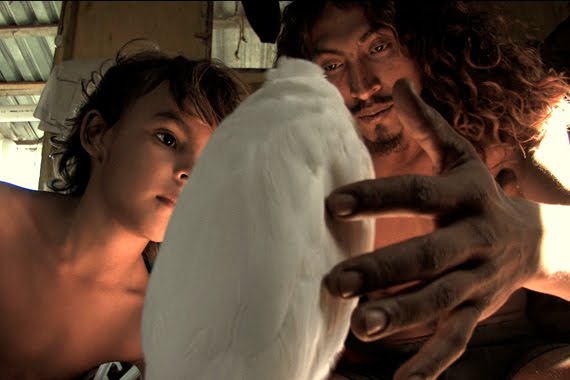
While González-Rubio’s focus remains squarely on the Banco Chinchorro and the life teeming around it, he’s a wise enough filmmaker to remove himself, rather than his human subjects, from the thematic equation. Alamar envelops Jorge Machado and his radiant son Natan into the cycles of the reef, not as exoticized objects, but as devotees to a life of beauty. The film hints at Natan’s parents’ divorce not as a divergent, shoehorned-in subplot, but as a revelation on Natan’s role in the film: he’s a gift, a reminder to his parents of their once-love, just as the reef stands as an implicit locus of environmental protection. Certainly, Alamar indulges in some expected narrative twists, most notably Natan finding a baby egret he must inevitably return to the wild. Thankfully, both González-Rubio and his (non)actors treat the episode quietly, in passing, not so much as a rite of passage (Natan starts young and stays young) as a simple fact of life for humans literally diving into nature.


In one of my most recent drunken ramblings, I concluded that there are only two nouns with which one can accurately describe a great film’s relationship to its audience. One is “pilgrimage,” and the other is “gift.” Alamar begins as the former, and reveals itself as an undeniable exemplar of the latter. This movie glows with generosity at every level, from character to environment and back, from camera to subjects and objects, from filmmaker to life, from screen to audience. The last missing link is from the audience back, and believe you me, you’ll be ecstatic to give it.


7. Wild Grass (dir. Alain Resnais)


So, to get this out of the way: Nearly fifty years after Last Year at Marienbad, Alain Resnais is still making movies, they’re still better than anything you’ve ever done, and the state is still paying for them. Suck on it.


Indeed, Wild Grass pulses with the bratty joy of an intermittently brilliant artist that ought to be well past his prime. Godard’s still throwing himself against the Nouvelle Vague’s prison walls, and his latest (yep, it’s called Socialisme) is blank-facedly didactic enough to derail his late-career revival. Resnais, to continue the metaphor, is better suited to tricking the guards out of their keys. And then replacing their guns with rubber duckies. I’m getting off track, which is probably his point.


Wild Grass dances through as many delirious monologues and cacophonous sound bridges and saturated slo-mos and visualized thought bubbles as possible, and each sets up and justifies the next. Although the film begins in the well-worn territory of a chance meeting, Resnais never defines the (increasingly perverse) relationship between the (increasingly perverse) central characters. Instead, he's interested in the sensorial ripples such a random occurrence can have on those affected, so that much of the film takes place nestled inside giddy expectation and wild fantasy. Wild Grass is unapologetically histrionic, stretching each scene well beyond the breaking point, but (crucially) never allowing its bubbling actors to break character or indulge in cheap irony. Is it a farce? Never. It’s a gift. The film subverts cliché for the sheer anarchic kick of it: Sabine Azéma’s strikingly masculine beauty overwhelms any of the traditionally seductive faces on screen, familial subplots begin as screwball distraction and then stay right there, and instead of knitting every dangling thread into place, that goddamn beautiful ending trips off like a terrarium take on 2001’s Journey Beyond the Infinite, closing on a girl curious about cat food.


I’m not doing a particularly coherent job of describing this movie, which wouldn’t worry me except that Wild Grass may sound snarky or masturbatory in the retelling, and it’s so, so not. It’s joyous and messy and vibrant, straining off the screen even as it gets more surreal. It does things with the color purple I’d never imagined possible. Watch it, watch it, watch it.


8/9. Eccentricities of a Blond Haired Girl & The Strange Case of Angelica (both dir. Manoel de Oliveira)


Speaking of the old guard, Manoel de Oliveira’s Wikipedia page takes as its second sentence: “He is currently the oldest active film director in the world.” Unlike Resnais, who seems bent on scattering his talent in as many directions as possible before death comes for him, Oliveira has only grown more in control of his aesthetic in recent years. His two latest features, however, when taken together, demonstrate how generous and inquisitive that aesthetic remains.


He’s sharp enough to cap Eccentricities at 64 minutes, allowing the gently surrealist romance to drift in and out like a crucial but passing episode. (I’m reminded of Eno’s “Another Green World,” a 102-second gem that places its emphasis firmly on fade-in and fade-out.) Angelica, by comparison, is left enough room to loop all the way back on itself, tying both the technical and divine threads of cinema together by bringing a dead woman to life before a photographer’s lens. Along the way, Angelica opens up further and further to the ineffable and unknowable, siding unashamedly with the madmen in pursuit of the universe, even as it continually reminds us of the weight of its post-WWII setting (Ricardo Trêpa’s protagonist Isaac is never allowed to forget his status as a Sephardic Jew). Eccentricities is less explicitly fantastic, but is equally elevated above the banal, filtering romance through windows and preserving an air of misty anonymity that threatens to send the film headlong into the ether. Both are thematically weighty, genre-bending works, but are both essentially humble, exploring the medium through slow pans and silent revelations, letting conversation dictate pace.


2010 was a film year like any other, complete with overstuffed librettos from occasionally-too-ambitious European filmmakers. Olivier Assayas’ Carlos and Luca Guadagnino’s I Am Love were simply too big too digest their pleasures comfortably (and, less charitably, too big to not include some gaping flaws). I’d never term Oliveira a minimalist filmmaker, so devoted is he to the little magical-realist riffs that characterize non-political Portuguese film. Yet by burrowing instead of painstakingly building, he creates films that glow in corners and angles, born to age as well as their 102-year-old maker. This cinema is life, and Manoel de Oliveira knows he’s still alive.


10. The Social Network (dir. David Fincher)


It would’ve been enough for The Social Network to have been acceptable, to not have been yet another example of old money failing utterly to come to terms with new money and wasting everyone’s money in the process. The movie passed that test, and more. But you know that already. So what’s left to say?


Yes, it’s very, very funny, but more importantly, it’s impossibly fleet. What separates worthwhile (or, occasionally, wonderful) Hollywood product from awards-bait bilge isn’t writing or acting; it’s editing. Banal shot-reverse-shot setups and plodding, linear cutting killed the studio drama. The Social Network succeeds—brilliantly—by staying constantly on the move, kinetically shifting between Facebook’s origin story and the agonizing fallout for its various creators. David Fincher follows up his decades-decaying masterpiece Zodiac by again destabilizing time, reflecting not only the phenomenal speed of Facebook’s genesis, but the earthshaking impact Mark Zuckerberg (et al) had on the social fabric of millions of lives. He was, indeed, an asshole, but he made a world. A world of assholes? Maybe, but…


But, again, you know what The Social Network is, and there are plenty of films that are those things that aren’t nearly as good. What makes The Social Network so (dare I say) important is what it isn’t. What it isn’t is an answer, and everyone involved deserves an Oscar just for that. Facebook and its creators don’t represent a question, they represent a phenomenon, one that the filmmakers are careful to present neither as a changer of Everything nor as just another progression of the zeitgeist. It’s something in between the wholly new and the Homeric-level old, a mixture of private and public and brilliant and scary and banal and awesome and, as the film emphasizes, more than a little sad. To paraphrase Isle of Flowers, it’s something that no one, including Zuckerberg himself, could fully explain, but also something that no one could fail to understand. If The Social Network carries a lesson, it’s not for Facebook, but for film: this is how to fill theaters while talking intelligently about the world. The only essential American movie of the year.


Best Director: Claire Denis for White Material


Best Cinematographer: Eric Gautiér for Wild Grass


Best Editor: Kirk Baxter and Angus Wall (what names!) for The Social Network


Best Writer: Maren Ade for Everyone Else


Best Actor: Kim Hye-ja for Mother

Friday, July 30, 2010

Day Break


No romance flick (or book, or play) is complete without the lie. It's the sturdiest of third-act twists, the simplest of disruptive conflicts, the easiest ending reveal. And it's not what you did, one of them will say. It's that you lied about it. You didn't trust me. You didn't trust us. How can I trust us, our story together?

Of the many delightful things about Richard Linklater's dazzling walking-around-European-cities duet, Before Sunrise and Before Sunset, near the top has to be the breezy avoidance of that standard arc. Perhaps "avoidance" is the wrong word; "translation" might be a better one. By centering the drama around time, and Jesse and Celine's choices at the inevitable endpoint, Linklater gives the two episodes a frame devoid of much narrative contrivance.

But the lie is there, and though Jesse and Celine help it along, it ultimately belongs to Linklater alone.

Upon its 2005 American release, Wong Kar-Wai's delirious, devastating 2046 was frequently compared to Before Sunset, and for good reason. Both were sequels to open-ended love stories, Wong's In the Mood for Love and Linklater's Before Sunrise. Both sequels played with issues of time, memory, and regret, watching their damaged protagonists fail to recover from the feelings they'd opened up in the golden-hued originals. That said, the filmmakers themselves utilize completely different languages. Wong, thanks in large part to cinematographer Christopher Doyle, has one of the most visually ravishing filmographies in recent memory. While In the Mood for Love played out like an exquisite portrait disrupted by unruly emotion, 2046 is feverish and spastic, its obscenely lush reds and interchangeably lovely paramours undercutting Mr. Chow's blind attempts to drown out his past failures.

Linklater, on the other hand, sets his diptych in two of the loveliest cities on Earth (Vienna and Paris, respectively), but refuses to indulge in much sky-gazing. Neither Sunrise nor Sunset establishes a distinctive visual framework beyond its protagonists' faces; it's only through Jesse and Celine, rootless wanderers and then careworn adults, that the audience can access the beauty of their surroundings. Linklater trusts dialogue like few directors working, and more importantly, he trusts his actors to shape that dialogue (it helps that Ethan Hawke and Julie Delpy co-wrote Sunset). His scripts are delightful in and of themselves, peppy and sharp, but in the hands of Hawke and Delpy, they become sacred: a constantly re-orienting glimpse into their hesitations, their wounds, and their desires.


But very rarely their lies. The novelty of random love in Sunrise was dangerous mystery enough, and while both characters' guards gradually fall throughout Sunset, they begin not in the realm of deception so much as distraction, letting timing carry them along to admit the most wrenching dependencies. No big reveal or third-act twist required--just talking, and a final choice, just like last time.

There's one exception, and it's jarring enough that I almost interrupted my first viewing of Sunset to frantically flip back to Sunrise, wondering how I'd missed it. "It" being, as usual, sex. Not far into Before Sunset, Jesse and Celine mask/reveal their overwhelming shock at seeing each other by discussing Jesse's new book, which tells the story of their night together nine years previous. Celine gently teases him for including a fabricated sex scene. Jesse, wounded, protests that they actually did screw that fateful night. Celine flatly denies it. Later on, she wearily admits that she remembers: "We had sex twice, you idiot!"

It wasn't the traditional big re-orienting lie that forever (i.e., until the credits) alters the romance. How could it? There's no foundation to Jesse and Celine's love, no established stable base for a betrayal to eat away at. They live in one night, and then nine years of memory: it's theirs to relive and remake. That's their lie, and I can't begrudge it to them.

It's Linklater's lie that intrigued me. For once, the audience isn't in on the game--as far as what we saw in Sunrise (namely, a conversation in which they decided not to bone), Celine was originally telling the truth and Jesse had embellished for the sake of his book. Celine's ultimate admission left me adrift. If they hadn't remembered wrong, had I?


I opened up Before Sunrise, skipped ahead to the cemetery scene. There they are, impossibly younger than they were just a few minutes ago. There, they have the conversation. There, they're snuggling. Cut, to the sunrise over the trees.

...oh. I'm impossibly stupid. Had I really missed the most basic of all cuts, the "guys-they-got-it-on-but-now-it's morning" maneuver? I had, after a lifetime of seeing that exact prim sidestep in film after film. How had I failed to understand?

Partially, of course, I took Jesse and Celine at their celibate word, trusting naif that I am. I also trusted Linklater, who'd lovingly displayed every awkward silence, every almost-fight, every teasing meta-conversation throughout the film; it honestly never occurred to me to look for the lie, the cut. I'm not criticizing Linklater in the least--much as I, uh, might enjoy a Hawke-Delpy sex scene, it would've been a massive stylistic departure, not to mention an invitation for a less viable rating. The cut is simple and unassuming, emerging almost out of respect for the couple's privacy rather than out of deference to audience sensibilities. Most importantly, though, it's Sunrise's clearest line forward to Sunset, pregnant with meaning and sadder to return to even than the first film's desperately open ending.

Before Sunset is one of the handful of films I'm happy to call my favorite. When I returned to watch Before Sunrise all the way through, I was prepared for it to be irreparably tarnished, paltry in the shadow of its impossibly resonant progeny. I was wrong: Sunrise, always a delight, is more moving than ever if you know what's coming. Nothing is casual any more. You know that every sweet moment will be pored over for years to come, fixed in amber-hued memory by beautiful people who can't forget. Fixed, and then blurred, shifted, changed, vanished. Sunset expands and deepens every idea presented in Sunrise, but Sunrise holds the weight of history over Sunset, and Linklater's greatest gift is that he refuses to pick sides. He lies in Before Sunrise, and the truth is tucked into Sunset like an askew corner of a puzzle piece. "Think of this as time travel," Jesse says with a grin, "from then to now." Two lies, but one truth.